

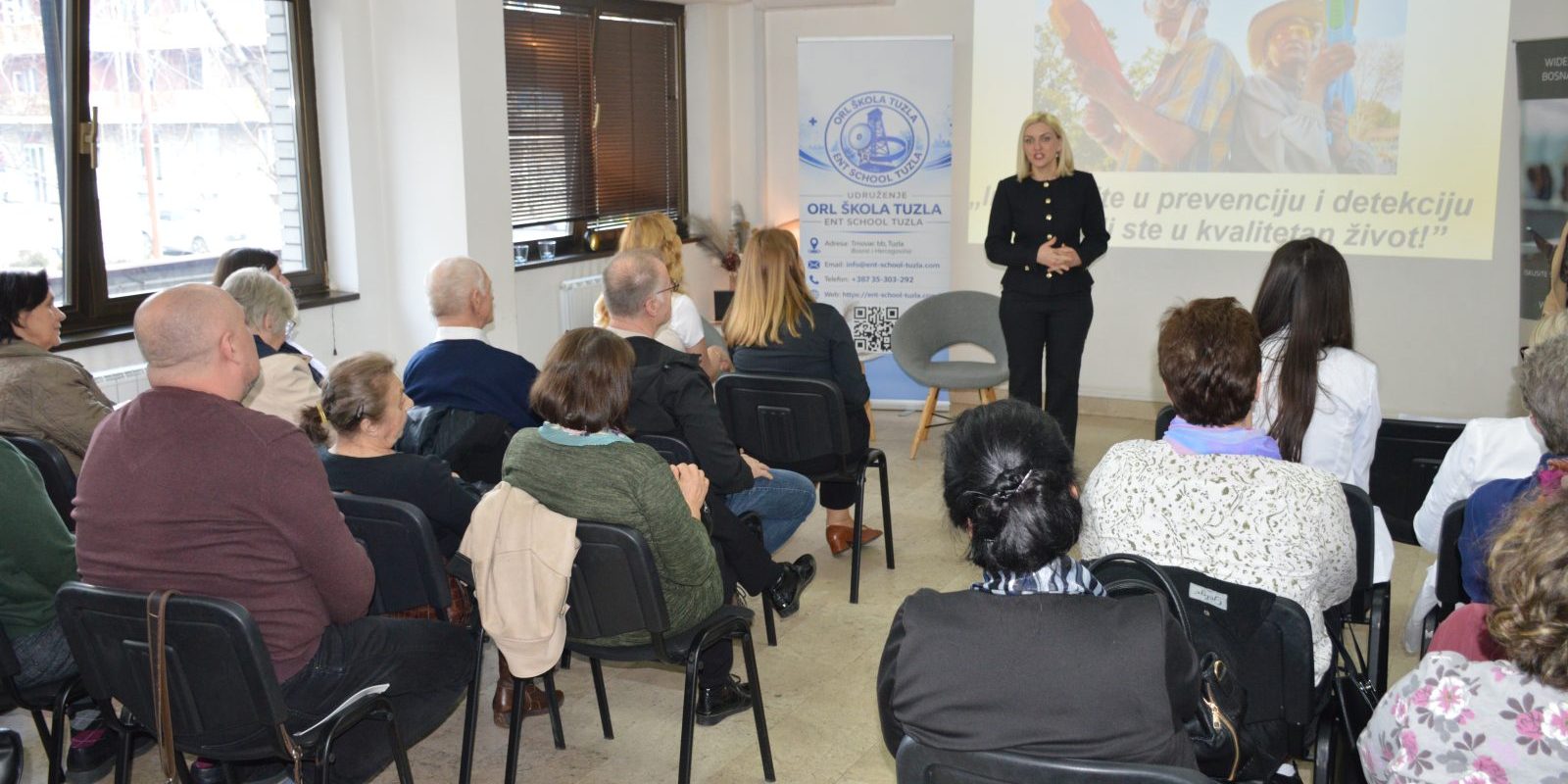
On the occasion of March 3- World Hearing Day, the University Clinical Center Tuzla (UKC Tuzla) organized a professional and educational event dedicated to raising awareness about the importance of prevention, early diagnosis, and contemporary treatment of hearing impairment.
The event was initiated by the ENT School Tuzla Association in cooperation with the Clinic for Ear, Nose and Throat Diseases and Head and Neck Surgery, and co-organized by the Department of Otorhinolaryngology of the Faculty of Medicine, University of Tuzla, the International Interactive Open Center (MIOC) Tuzla, and WIDEX Hearing Aids Tuzla.
Participants had the opportunity to attend expert lectures delivered by Assoc. Prof. Dr. Almedina Ramaš, ENT specialist and subspecialist in audiology, and Assoc. Prof. Dr. Lejla Pirić, surdoaudiologist. In addition to the educational segment, visitors were offered free otolaryngological examinations and hearing tests conducted by the staff of the Audiology Department of the Clinic for Ear, Nose, Throat and Head and Neck Surgery.
Acting Head of the Clinic and President of the ENT School Tuzla Association, Assoc. Prof. Dr. Majda Mujić, specialist in otorhinolaryngology, emphasized that World Hearing Day serves as an important reminder of the vital role hearing plays in emotional, social, and cognitive development. She highlighted that the Clinic continuously conducts newborn hearing screening starting from the second month of life. Special attention is also devoted to preschool children, a period often marked by frequent ear infections and increased antibiotic use, both of which may affect hearing and speech development. Dr. Mujić stressed the importance of early recognition of warning signs, such as increasing the volume on televisions and mobile devices, failure to respond to calls, delayed speech development, or declining school performance.
“Hearing is our connection to the world and to our loved ones, which is why timely reaction is essential. Our Clinic provides comprehensive diagnostics and rehabilitation services for patients of all ages. We are particularly proud of our cochlear implantation program. This year marks 25 years since the first cochlear implant was performed at our institution. To date, 67 implants have been successfully placed, and the entire process , from diagnostics to postoperative rehabilitation, is carried out within our Clinic,” emphasized Dr. Mujić.
The cochlear implantation program represents one of the most significant segments of the Clinic’s work, enabling children with severe hearing impairment to develop speech, enhance communication skills, and significantly improve their overall quality of life through advanced medical rehabilitation.
Prof. Dr. . Fuad Brkić, ENT specialist and subspecialist in audiology, underscored the crucial importance of timely detection of hearing impairment. According to him, early recognition allows therapy to begin at a stage when consequences are considerably milder and treatment outcomes far more successful. He explained that milder forms of hearing loss are managed with hearing aids, while patients with profound hearing impairment are referred to the cochlear implantation program.
“The key lies in early detection and prompt treatment. Even a single exposure to excessive noise such as loud music, playing video games with headphones at high volume, or prolonged stays in nightclubs can result in so- called acoustic trauma and permanent hearing damage. This is why prevention is of utmost importance. Current estimates indicate that the number of people with hearing impairment will continue to rise, largely due to modern lifestyles and insufficient attention to preventive measures,” emphasized Prof. Brkić.
Assoc. Prof. Dr. Almedina Ramaš, ENT specialist and subspecialist in audiology, highlighted the vital role of parents and teachers in recognizing early signs of hearing difficulties in children. Warning symptoms may include a sensation of ear fullness, ringing in the ears (tinnitus), communication difficulties, or inability to hear high-frequency sounds. In children, additional indicators can include delayed or underdeveloped speech, speech regression, and greater reliance on visual cues rather than auditory input.
“Older individuals should not feel fear or embarrassment about using hearing aids. When hearing is significantly impaired, a hearing aid can greatly enhance quality of life and help preserve cognitive function. Research shows that the risk of dementia can be reduced by up to 40% in elderly patients who regularly use hearing aids, as these devices enable better communication and more active use of cognitive abilities,” emphasized Assoc. Prof. Dr. Almedina Ramaš.
Ezida Šerak, a long- term hearing aid user, attended the World Hearing Day event to learn about the latest advancements in hearing technology. She shared that she has been using a hearing aid for nearly fifteen years and that modern devices allow her to function normally in everyday life. Although people with hearing impairment often face misunderstanding from society, she noted that she overcomes such challenges with optimism and maintains a positive attitude toward the assistive technologies that make her daily activities easier and more fulfilling.
The World Hearing Day program brought together participants of all generations, from children to senior citizens. All attendees were encouraged to take continuous care of their hearing health and to make use of the modern diagnostic and therapeutic services available at the Clinic for Ear, Nose and Throat Diseases and Head and Neck Surgery.