

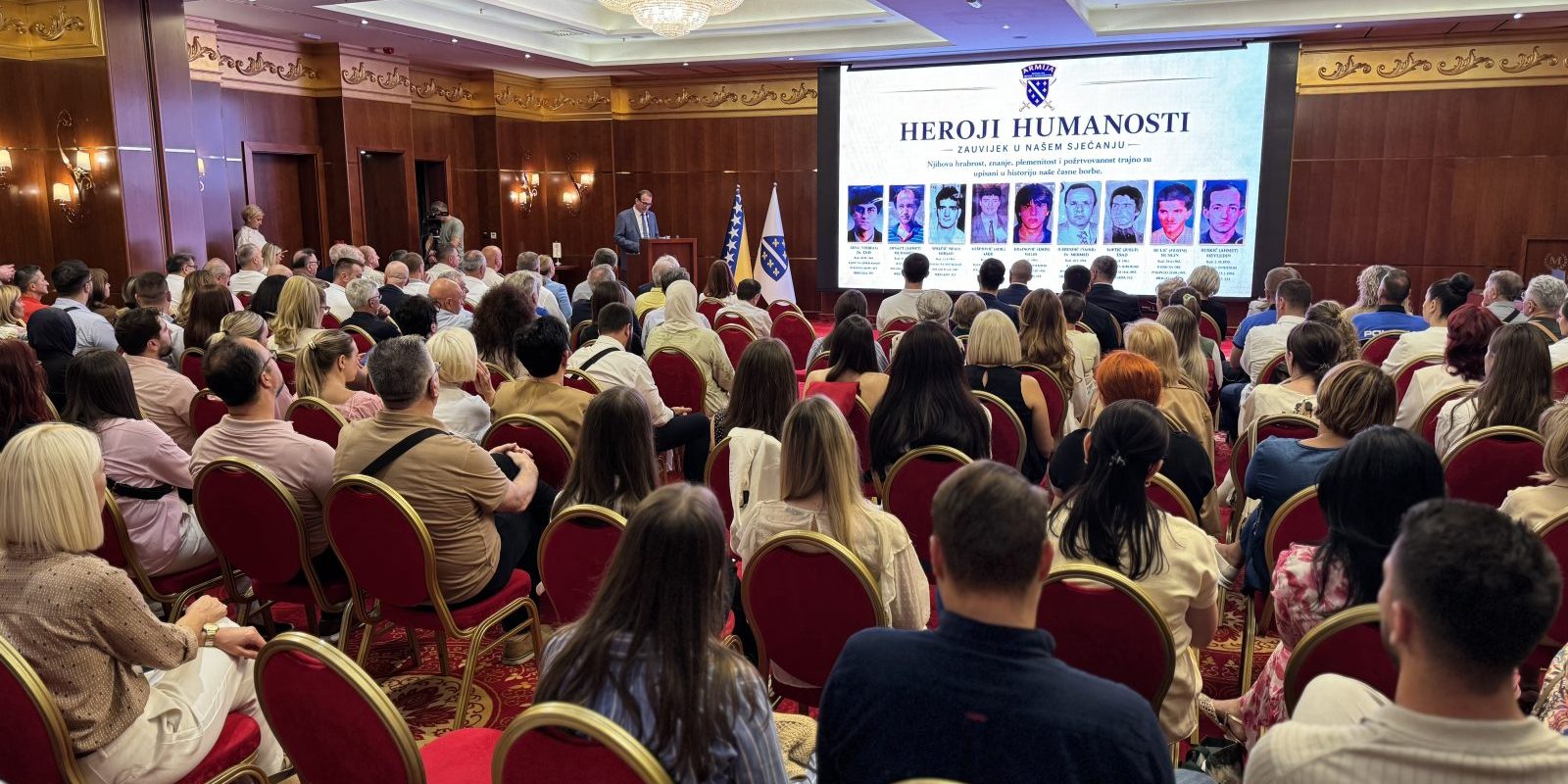
The University Clinical Center Tuzla (the UKC Tuzla), in collaboration with its project partners, the Ministry of Education and Science of Tuzla Canton and the Student Council of the Faculty of Medicine in Tuzla, Medicus, organized the scientific and professional symposium entitled “Organization of Care for the Injured and Sick at the University Clinical Center Tuzla, 1992–1995.” This was the fourth symposium in a series of scientific and professional events held as part of the institutional commemoration of the genocide committed against Bosniaks during the aggression against the Republic of Bosnia and Herzegovina.
“We must know and permanently remember those difficult times when we faced the immediate realities of war, a large influx of refugees and displaced persons, and the constant emergence of new battlefields and front lines. At the same time, the UKC Tuzla was confronted with a significant departure of healthcare professionals. Despite these extraordinary circumstances, the remaining department heads, experienced physicians, and healthcare workers succeeded in organizing the institution’s work and ensuring the uninterrupted provision of healthcare services. A particularly valuable contribution was made by healthcare professionals registered with the Employment Service, who voluntarily placed themselves at the disposal of the UKC Tuzla, as well as by numerous medical students who actively participated in the care of the injured and the sick. From the very beginning, the idea behind institutionally commemorating the genocide committed against Bosniaks has been to preserve the truth through a scientific and professional approach, to transfer knowledge and experience to future generations, and to share these lessons with colleagues from around the world. I believe we have largely achieved this objective, establishing this symposium as an internationally recognized forum for scientific dialogue and the exchange of professional experiences. It is our responsibility to scientifically document these experiences, preserve them from oblivion, and pass them on to future generations as a lasting testimony to the dedication and invaluable role of healthcare workers in protecting human life and dignity under the most challenging circumstances,” said Director Umihanić.
Director Umihanić also announced the production of a documentary film on war surgery during the aggression against the Republic of Bosnia and Herzegovina. The project will be realized in cooperation with the Ministry for Veterans Affairs of Tuzla Canton. Through authentic testimonies of physicians, nurses, medical technicians, and other healthcare professionals, the documentary will preserve the memory of the extraordinary dedication and sacrifice of healthcare workers who defended human life, humanity, and human dignity under the most challenging wartime conditions.
Among the healthcare professionals who made an outstanding contribution during the aggression against the Republic of Bosnia and Herzegovina was Prof. Dr. Mirsad Hodžić, a neurosurgeon, who selflessly devoted himself to the care of the injured and the sick at the UKC Tuzla. As a direct participant and witness to the organization of healthcare services during the war, Professor Hodžić addressed the symposium, sharing his firsthand experiences and reflecting on the immense professional and humanitarian challenges that healthcare workers faced on a daily basis.
“The period was, I would say, extremely turbulent. At first, we all hoped that the war would be short- lived. Every day, we expected the influx of large numbers of injured patients to cease and the fighting to come to an end. Unfortunately, the war continued, and over time we had to adapt to the harsh realities of wartime, which brought countless challenges. We faced shortages of medical supplies and logistical support, while the departure of healthcare personnel placed an additional burden on those who remained. Nevertheless, I believe we responded successfully and ultimately endured far longer than we had initially thought possible,” emphasized Professor Mirsad Hodžić.
A special contribution to the care of wounded soldiers and the civilian population during the aggression was made by Prof.Dr. Jacob Bergsland, a war surgeon with the Nordic Battalion stationed in Šićki Brod, who was among the invited lecturers at the symposium.
Reflecting on his wartime experience, Professor Bergsland recalled the exceptionally demanding working conditions, emphasizing that providing surgical care required outstanding professional expertise, efficient organization, and the unwavering commitment of the entire medical team. He noted that while the capabilities of modern surgery have advanced immeasurably since the war, the knowledge and experience gained during that period remain of enduring value to healthcare professionals.
Professor Bergsland’s collaboration with the University Clinical Center Tuzla continued long after the end of the war. In the post- war period, he made a significant contribution to the establishment and development of cardiovascular surgery at the UKC Tuzla, helping to strengthen one of the institution’s most important surgical specialties.
The symposium brought together numerous healthcare professionals, university professors, researchers, and students, reaffirming the importance of continuous scientific research, the preservation of historical records, and the documentation of the experiences of the healthcare system during the aggression against the Republic of Bosnia and Herzegovina. The event once again highlighted the essential role of healthcare workers in safeguarding human life and dignity under the most difficult circumstances and underscored the importance of preserving these experiences for future generations.