

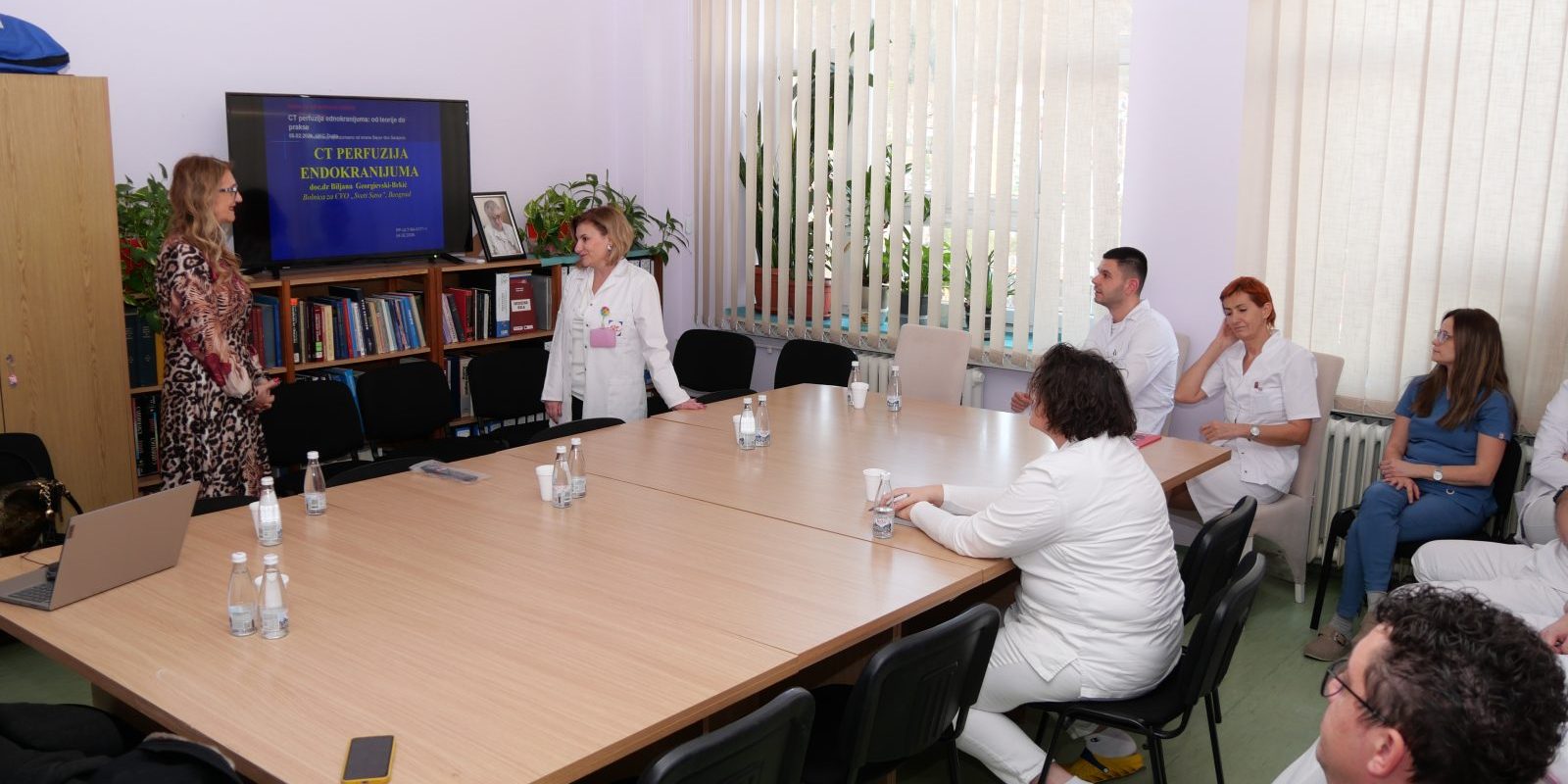
A professional workshop on endocranial CT perfusion was held at the Clinic for Radiology and Nuclear Medicine of the University Clinical Center Tuzla, led by Assoc. Prof. Dr. Biljana Georgievski-Brkić from Belgrade.
Assoc. Prof. Dr. Georgievski-Brkić is visiting UKC Tuzla as part of this educational program, which includes plenary lectures on CT perfusion of the endocranium, accompanied by detailed case presentations, as well as a practical, hands- on training segment aimed at strengthening diagnostic competencies in neuroradiology.
She is a specialist in radiology with a subspecialization in neuroradiology and currently serves as Head of the Department of Radiological Diagnostics at the Special Hospital for Cerebrovascular Diseases “Sveti Sava” in Belgrade.
During her professional career, Assoc. Prof. Dr. Georgievski- Brkić has completed advanced education and training in Chicago, where she gained valuable experience at a prestigious university center specializing in neuroradiology. She is the author and co-author of numerous scientific and professional papers published in respected medical journals.
During her presentation, Assoc. Prof. Dr. Biljana Georgievski- Brkić emphasized that acute ischemic stroke is a disorder of brain function resulting from vascular injury, most commonly caused by occlusion or embolism of a cerebral blood vessel. She explained that, unlike a standard CT examination of the endocranium, CT perfusion is an advanced diagnostic method that enables precise assessment of the localization and extent of brain infarction in the very early hours following the onset of acute ischemic stroke symptoms. Within the ischemic area, CT perfusion allows differentiation between the infarct core, representing irreversibly damaged brain tissue, and the penumbra, an area of reduced perfusion with potentially reversible tissue injury.
For this reason, CT perfusion serves as an important decision-support tool in the selection of patients for intravenous thrombolytic therapy and mechanical thrombectomy, contributing to timely and targeted treatment of acute ischemic stroke.
The Head of the Clinic for Radiology and Nuclear Medicine, Prof. Dr. Svjetlana Mujagić, also addressed the attendees, emphasizing that radiological diagnostics represents a key segment in the detection and treatment of diseases, particularly in the management of acute stroke. “Radiological diagnostics involves the application of various imaging techniques to obtain precise and reliable images. The speed and accuracy of imaging are crucial, as they enable medical professionals to quickly and accurately identify the type and localization of a stroke, allowing patients to receive appropriate therapy in a timely manner, which significantly improves treatment outcomes and recovery,” Prof. Dr. Mujagić stated.
She further emphasized that the clinic’s goal is the integration of advanced radiological diagnostic methods into everyday clinical practice. On this occasion, she expressed her gratitude to Assoc. Prof. Dr. Biljana Georgievski- Brkić for responding to the clinic’s invitation, as well as to the management of the University Clinical Center Tuzla, led by Director Prof. Dr. Šekib Umihanić, for recognizing the importance of and supporting the implementation of educational and professional development projects.
The workshop was held with the support of Bayer Pharmaceuticals d.o.o. Sarajevo.